
AEP that miscalibration fixes can often recover, depending on severity
SCADA-driven wind farm performance
Recover hidden AEP from the wind farms you already operate.
ventodyne helps wind farm owners and operators identify underperformance, quantify wake-steering potential, and deploy control strategies backed by SCADA data, calibrated models, and field validation.
Potential annual yield improvement from wake steering in suitable wind farms
Additional sensors required for windalytics Alignment
- Commercial field deployment
- Toggle-tested uplift verification
- No additional sensors required for Alignment
- TU Munich spin-off
Where value gets lost
Most wind farm losses are not obvious from routine monitoring.
Hidden performance loss often sits in the overlap between wake effects, yaw and vane miscalibration, and turbine-specific underperformance. Operators usually already possess the raw data. What is often missing is a method that can separate noise from recoverable value.
Wake losses
Even well-designed parks lose energy to wake interactions. The commercial question is whether those losses can be reduced in a measurable and operationally practical way.
Misalignment and calibration drift
Yaw and wind-vane issues can quietly reduce production across a fleet while remaining hard to isolate with standard dashboards alone.
Quiet underperformance
Turbines can fall behind expected behavior long before the issue becomes obvious. SCADA patterns often contain the evidence, but not the diagnosis.
Solutions
Start with the question you need answered.
ventodyne offers three entry points into wind farm performance improvement, from low-effort diagnostics to full wake-steering deployment.
windalytics for dewake
Assess wake-steering potential
Quantify where wake steering is likely to create value, how much AEP uplift is realistic, and which turbines should be prioritized before deployment decisions are made.
windalytics Alignment
Diagnose hidden underperformance
Run a fleet-wide SCADA check for yaw and vane miscalibration, hidden underperformance, and drift patterns without installing additional measurement equipment.
windalytics Custom
Answer a specific asset question
Use client-specific SCADA analysis and wind-farm modeling to evaluate wake losses, verify uplift after operational changes, assess deterioration trends, or support repowering and due-diligence work.
Deployment path
dewake moves from analysis into control deployment.
When the opportunity is there, ventodyne transitions from assessment into a wake-steering workflow designed for measurable uplift, practical integration, and post-deployment verification.
Workflow
From raw SCADA data to defensible performance action.
The workflow is designed to reduce decision risk. Analysis comes first, then deployment, then validation.
01
Import and clean the data
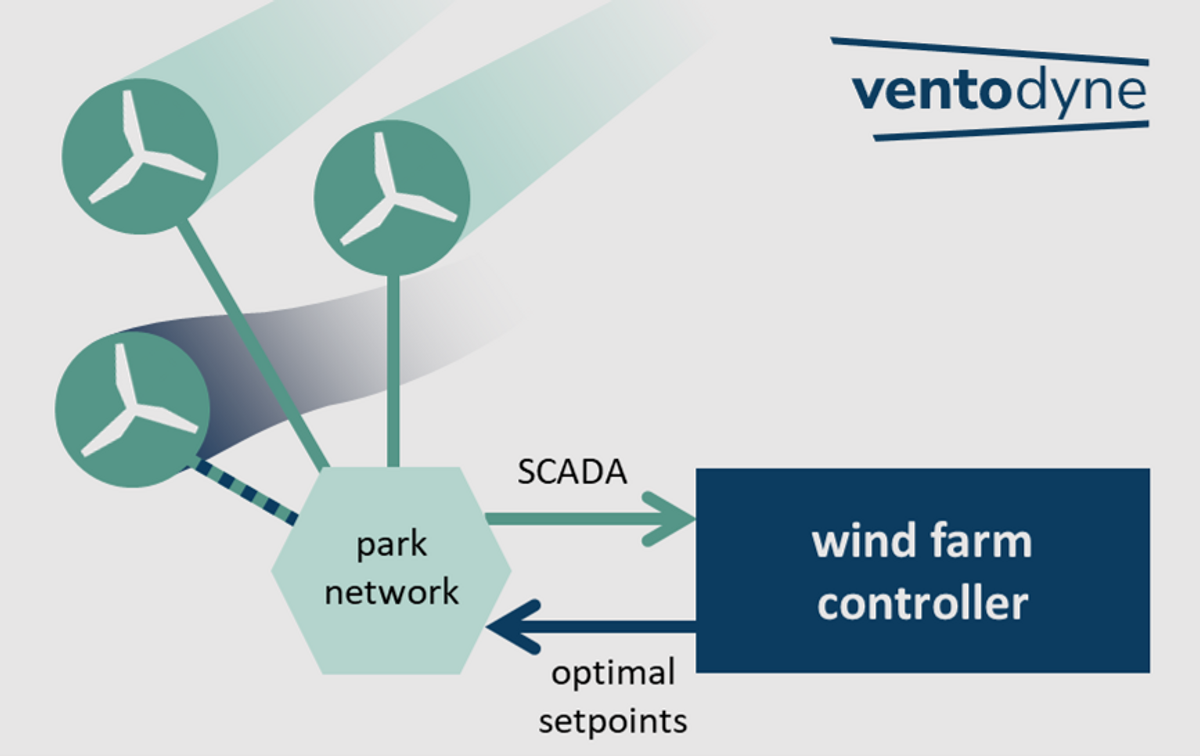
Work from historical SCADA exports, turbine specifications, and farm layout rather than asking for bespoke measurement campaigns up front.
02
Reconstruct conditions and calibrate the model
Estimate ambient wind conditions from available signals and calibrate a wind-farm model against measured turbine behavior.
03
Quantify realistic value
Estimate recoverable uplift, identify priority turbines, and show where uncertainty matters before operational decisions are made.
04
Deploy or recommend action
Translate the analysis into a prioritized diagnostic action plan or a wake-steering deployment path, depending on the use case.
05
Verify with robust methods
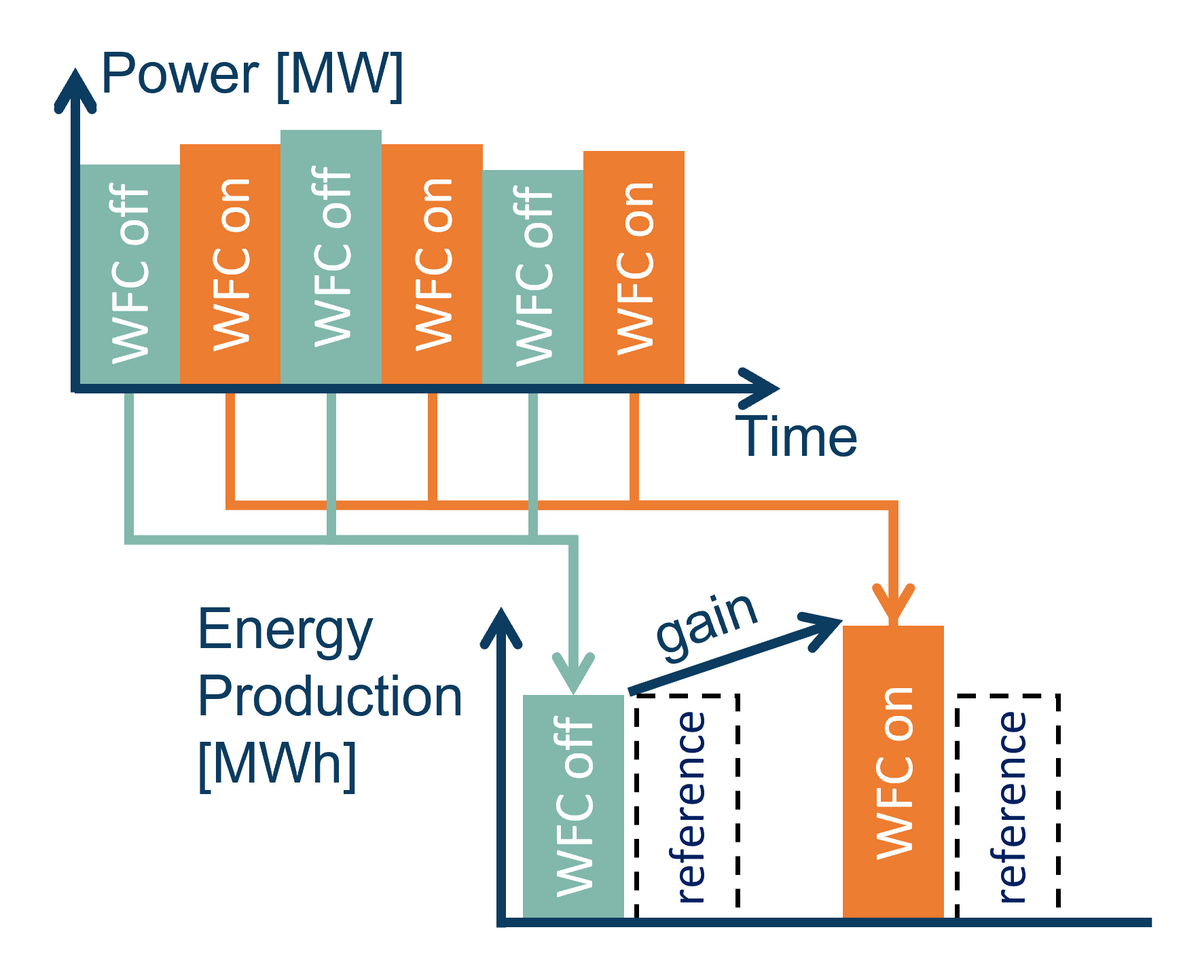
Use field-tested comparison methods to measure whether expected gains actually materialize under real operating conditions.
Commercial proof
Demonstrated at a commercial wind farm with Energiekontor AG.
ventodyne and Energiekontor brought wind farm control to the Withernwick wind farm, an onshore site with 13 closely spaced turbines. A six-month toggle-test campaign provided clear quantitative evidence of uplift and confirmed the accuracy of ventodyne's pre-deployment estimates.
- 13-turbine onshore wind farm
- 6-month toggle-test campaign
- Field validation of predicted uplift
- Joint work with Energiekontor AG
Technology
Built for practical deployment, not theoretical elegance alone.
ventodyne combines SCADA-based condition reconstruction, wind-farm modeling, setpoint optimization, and robust validation into a workflow that can predict value before deployment and verify it afterward.
Existing infrastructure first
The workflow is designed around the data and systems operators already maintain, lowering the barrier to evaluation and deployment.
Model-driven decisions
Recommendations and control actions are based on calibrated wind-farm models rather than generic rules or dashboard heuristics.
Measurable outcomes
The emphasis stays on what can be defended technically and validated operationally, not on optimization claims that disappear under scrutiny.
Why ventodyne
Independent, technically rigorous, and focused on measurable operator value.
ventodyne is a TU Munich spin-off founded by Johannes Schreiber and Carlo L. Bottasso. The company translates years of wind farm control research into operator-ready diagnostics and control workflows. Its independence supports decision-making grounded in technical rigor, scientific integrity, and long-term customer value.
- Founded in 2022 in Munich
- Independent and founder-financed
- Deep expertise in wind farm control and analysis
- Research background translated into field-ready workflows

Choose a starting point
Different problem. Same performance mindset.
Check my fleet for hidden losses
Best fit for operators who suspect misalignment, drift, or unexplained underperformance across multiple turbines.
Evaluate wake-steering potential
Best fit for wind farms where wake interactions are likely significant and the commercial case for control needs to be quantified first.
Scope a custom analysis
Best fit for operator, due-diligence, or repowering questions that need a model-driven answer rather than a generic report.
Contact
Bring a concrete wind farm question.
Share the asset context, the available SCADA history, and the question you want answered. ventodyne will outline what can be assessed, what data is needed, and where the likely value sits.
Typical inputs
- Historical SCADA data export
- Farm layout and turbine types
- Operational question or target outcome
Direct contact
info@ventodyne.com
Gaisbergstraße 16
81675 Munich, Germany